Helping a Health Services Startup Show Up in AI Search
Mapped when ChatGPT, Gemini, Google, and Perplexity mentioned the business, where they missed it, and which website fixes could make it easier to find.
Project overview
Helping a Health Services Startup Show Up in AI Search overview
A short overview of the problem, solution, and result.
Starting Point
A health-services startup wanted to understand how it showed up when people asked AI tools about at-home blood testing and related services.What Shipped
Tested 74 search situations, checked 33 directly in the browser, and added 12 final rechecks.Why It Mattered
Turned a question about AI search into a clear report showing where the business appeared, where it was missing, and what the website team could fix.Summary
A health-services startup wanted to know how it showed up when people asked AI tools for help with at-home lab testing and related services.
I checked what the public website and major AI search tools could see, found the searches where the business appeared or went missing, and turned the results into a private report with clear next steps. This case study covers the review and report, not a claimed ranking or sales lift.
The situation
When someone asks an AI tool for a local health service, the answer depends on what the tool can find, which sources it trusts, and how clearly the business is described online.
The founder needed to know which searches already mentioned the business, which searches missed it, and which fixes were realistic enough to discuss with a website team.
Constraints
Use public evidence only.
The audit did not have a private search dashboard, analytics account, website admin, or server access. That made the boundary clear: inspect the public website, public blog, what search engines could see, and live AI answers.
Do not change the site during diagnosis.
Recommendations had to be useful without making live changes first. The output needed to help the founder talk with a developer or give clear tasks to someone helping with the website.
Keep health-service claims cautious.
The public case study avoids private client details and does not claim medical, compliance, ranking, or conversion outcomes that have not happened.
What the report covered
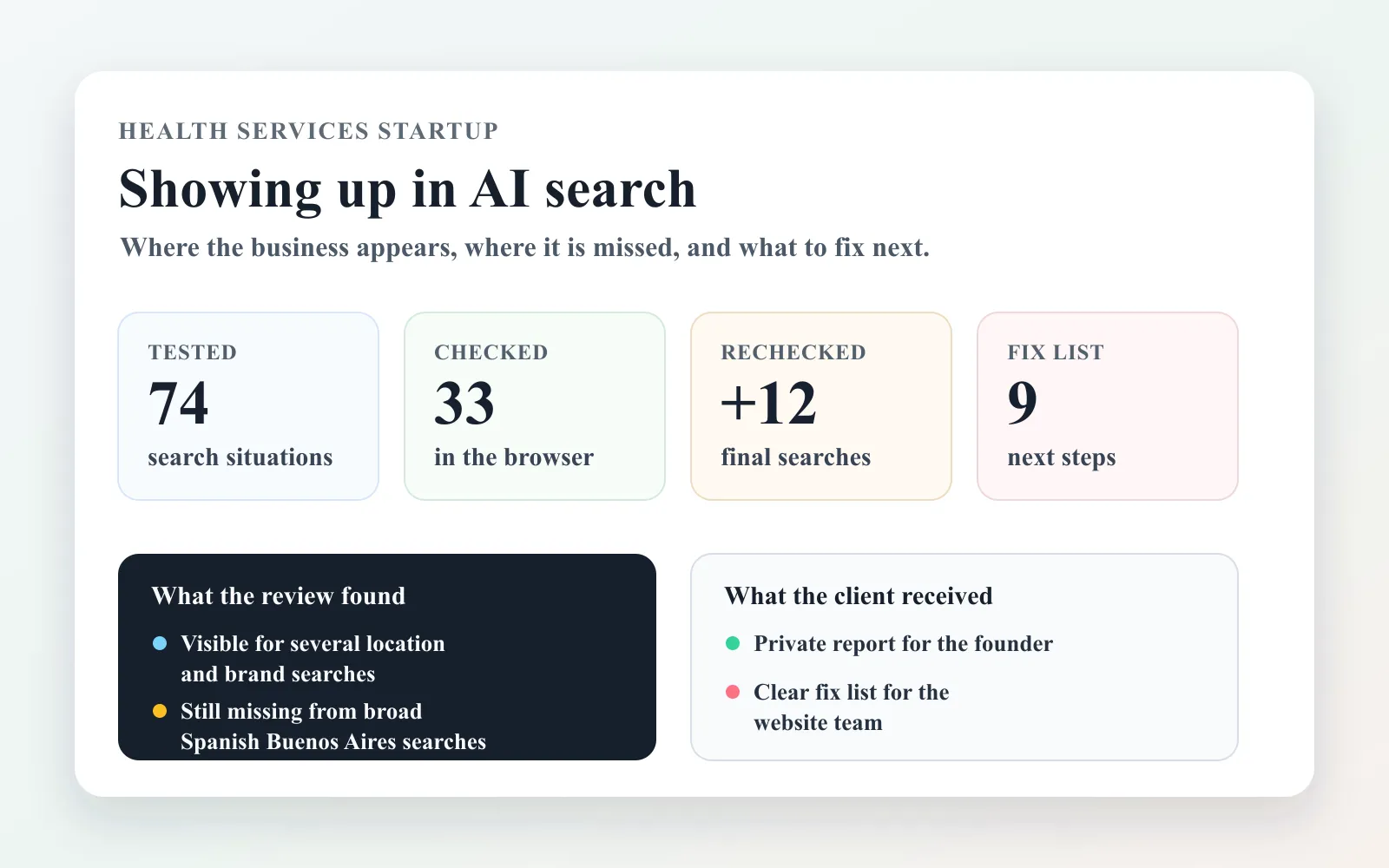
The preview shows the shape of the private report: what was checked, what appeared in AI answers, what was missing, and what to fix next.
What I reviewed
Site and blog setup.
The main site appeared to be custom-coded, while the blog appeared to be a separate WordPress site. That split matters because AI tools may read the main site and the blog differently.
Can search engines read it?
The site had useful site maps and pages that search engines could read. The main site’s
search-instructions file, robots.txt, returned 404 during the audit, which became a concrete fix
instead of a guessed blocker.
Clear labels for the business and services.
Some detail pages had machine-readable labels for FAQs, page type, and breadcrumbs. The homepage, city pages, and about page did not clearly label the business and its services, so the fix was to make that context explicit.
AI answer testing.
The final evidence file covers 74 search situations: 15 Perplexity answers, 8 live web-search checks, 33 results checked in a browser, and 18 older manual notes kept for history. The final browser retest added 12 checks across ChatGPT Search, Gemini, and Google AI Mode / AI Overview.
What the tests showed
The earlier unknowns were checked directly.
Direct browser checks now cover every earlier manual follow-up item. The older manual notes remain in the spreadsheet for history, but the browser-checked results are the current evidence.
The evidence separated where the company appeared from where it did not.
ChatGPT Search still missed broad Spanish Buenos Aires at-home blood-test searches. Gemini still missed Spanish Medellin sexual-health searches. Google and ChatGPT now mentioned the company for several Medellin and brand-name searches.
The result is a reusable review, not a claimed increase in AI mentions.
The working files give the founder and whoever helps with the site a test-question list, results spreadsheet, source notes, fix notes, and handoff notes. It does not claim that the recommendations have been implemented or that AI mentions improved after implementation.
What the client received
A private report with a clear fix list.
The private report includes an overview, first fixes, next improvements, results, monthly checks, appendix material, and 9 website fixes without putting the private report on the public portfolio.
Access is private and search engines are blocked.
The report site requires a password before showing the content and tells search engines not to list it. The public case study does not include the protected URL, password, or client-sensitive report details.
The delivery is verified, but the business impact is not claimed.
The private report builds and checks locally, and the live private site blocks public access as expected. That verifies delivery, not implementation by the client or a measured increase in AI mentions.
What the client can use
The value of the work is that the founder can see where the business appears, where it does not, what sources seem to matter, and which website fixes should be tried first.
Starting point
I checked what people and AI tools could actually find.
The first pass reviewed the public website, blog, site maps, search access rules, page text, headings, and labels before recommending changes.
Search tests
The review tested 74 search situations.
The final files show how Perplexity, ChatGPT Search, Gemini, Google, and live web search handled Spanish and English questions.
Final check
The final pass closed the earlier unknowns.
I rechecked the open items directly in the browser, so the current evidence includes 33 directly checked results.
Findings
The business appeared in some valuable searches and missed others.
Google and ChatGPT now mention the company for several Medellin and brand-name searches. ChatGPT still misses broad Spanish Buenos Aires at-home blood-test searches, and Gemini still misses Spanish Medellin sexual-health searches.
Next steps
The findings became a private report with 9 clear fixes.
The report gives the founder and website team a prioritized fix list, supporting evidence, and a monthly check-in plan.
Deliverables
Early diagnostic files.
The first deliverables were a practical AI-search checklist and a longer diagnostic PDF, created before the follow-up conversation so the discussion could start from concrete evidence.
Private report.
The private report site is built from the evidence files and password-gated. The public page does not include the protected URL, password, or client-sensitive report details.
Evidence files.
The final files include the test-question list, results spreadsheet, source observations, fix notes, and handoff notes so the findings can be reused, rechecked, or handed to someone making the fixes.
What could be added later
The evidence counts and private report delivery are now represented. The remaining updates depend on a real follow-up or fixes made from the report.
Add an approved report screenshot, any approved client quote or follow-up result, and any before/after metric from implemented recommendations.
Tech Stack
Have a workflow ready to become software?
I design and build internal tools, automations, dashboards, integrations, and AI-assisted workflows around the people who need to use them.