Codex Telegram Bridge
Lets remote updates reach Telegram or Discord while approvals, access, and delivery stay under local control.
Project overview
Codex Telegram Bridge overview
A short overview of the problem, solution, and result.
Starting Point
Codex could keep working after I left the computer, but the control surface stayed pinned to the local app: a waiting prompt, approval, or completed answer was easy to miss until I returned.What Shipped
Shipped a Rust CLI, daemon, Telegram and Discord transports, project registry, native macOS menu bar app, and bounded MCP adapter.Why It Mattered
Shipped a public bridge with install docs, Telegram and Discord setup guides, release workflow docs, CI, security notes, and a native macOS menu bar companion.Summary
Codex Telegram Bridge is a local bridge for controlling Codex when I am away from the computer.
Telegram or Discord becomes a remote continuation surface for Codex threads, but chat is not the system of record. The Rust daemon owns sync, routing, retries, presence state, and delivery. Telegram, Discord, and Hermes are interfaces into that local system.
The situation
Codex can keep working while I step away, but the default interaction model assumes I am still in front of the desktop app.
A message alone would not solve it. The bridge needed to know when I was away, start or repair the shared live backend, notify only for relevant events, let me reply to the right thread, handle approvals, and stop cleanly when I returned.
How it works
Make presence the top-level gate.
The README and CLI center one product rule: no remote notifications while I am present. /away and remote on make outbound delivery explicit. /back and remote off disable delivery and clear pending outbound events.
Let local state own routing.
The bridge stores thread snapshots, outbound events, delivery logs, message routes, callback routes, inbound update dedupe rows, selected projects, and action history in local SQLite. Remote chat messages carry route handles. Local state maps them back to Codex.
Separate transport from agent control.
Telegram and Discord own delivery and reply UX. Hermes gets a small MCP adapter for trusted local agent workflows. The MCP server can inspect, reply, and approve, but it does not install the daemon, configure transports, process chat updates, or own proactive notifications.
Product surface
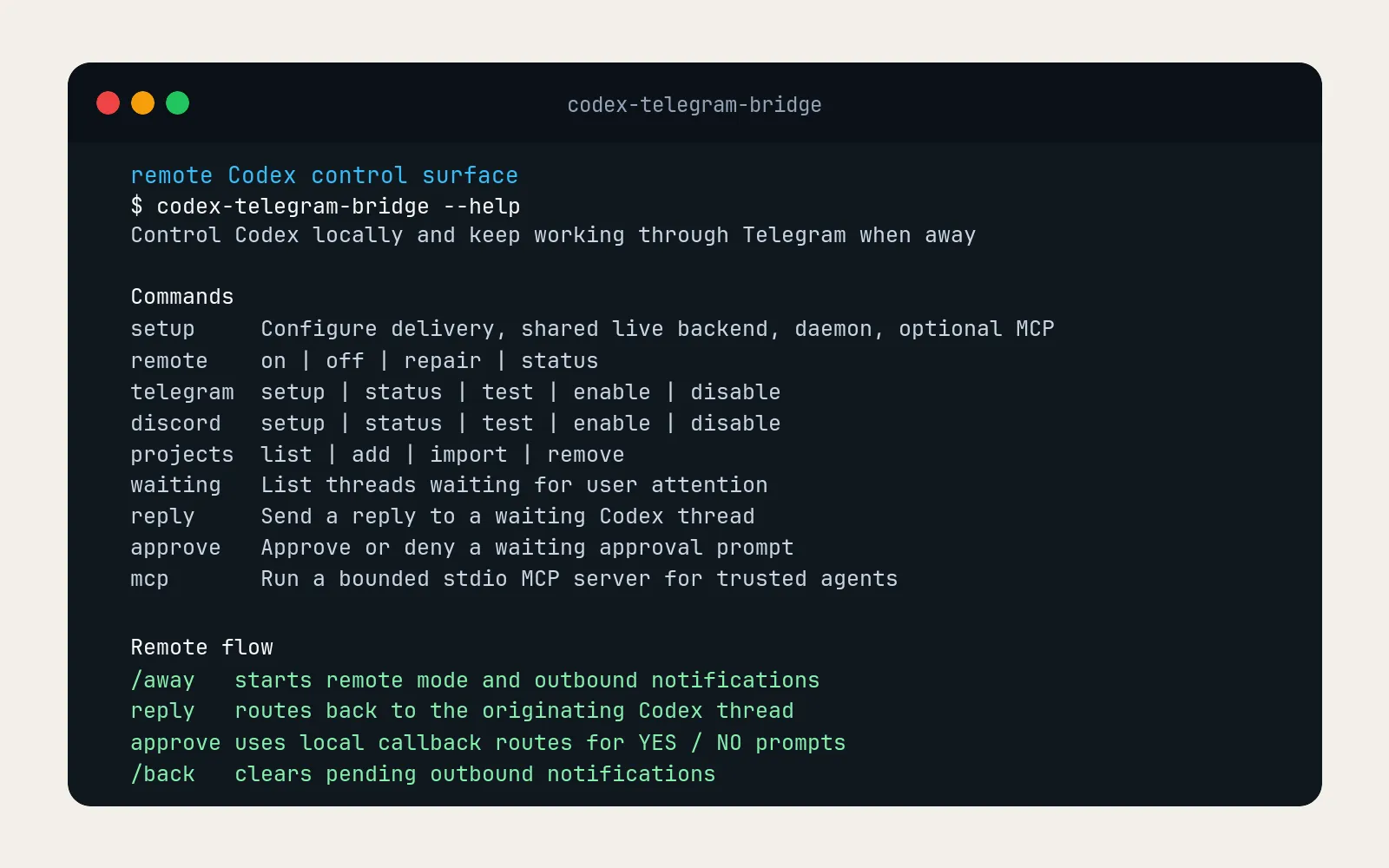
The public surface is intentionally plain: install the Rust CLI, run setup, use /away before leaving, reply to bridge messages when Codex needs input, and use /back when returning.
What I built
A CLI shaped around the default path.
The visible commands emphasize setup, remote mode, daemon management, transport setup, project selection, waiting threads, replies, approvals, and MCP. Advanced maintenance commands are still available, but hidden from default help.
Daemon-owned delivery.
The daemon syncs Codex state through the configured shared websocket backend, reconciles that backend only when remote mode requires it, enqueues new events after the away session starts, delivers due outbound events, and polls Telegram or Discord for replies.
Routable replies and approvals.
Telegram notifications store local message routes. Approval prompts use opaque callback route ids with Approve and Deny buttons. Discord reuses the same prepared delivery model, then maps reply messages back through the local route table.
Project selection without guessing.
The project registry stores explicit working directories with ids, labels, and aliases. /project selects the current workspace, and /new starts a Codex thread in that registered cwd instead of guessing from chat text.
Secret-safe output.
Setup writes the bridge config with user-only permissions, command output redacts bot tokens, allowed user ids can restrict inbound commands, and the public docs call out dedicated bot-token ownership and local retention.
A practical desktop control.
The macOS menu bar app embeds or resolves the bridge binary and exposes the actions needed from the desktop: start, stop, repair, refresh status, open config, and open state.
What shipped
Codex Telegram Bridge turns an agent workflow into a controlled local product. It defines ownership boundaries first, then adds automation where state, routing, and recovery are explicit.
Public CLI
The stable surface is a Rust command line tool.
Default help exposes setup, doctor, away, remote, daemon, Telegram, Discord, projects, waiting, inbox, show, reply, approve, MCP, and Hermes commands. Lower-level sync, watch, follow, fork, archive, and unarchive commands stay hidden.
Presence gate
Remote notifications only run when remote mode is on.
`/away` starts or reuses the shared Codex live backend and enables outbound Telegram or Discord notifications. `/back` turns the gate off and clears pending outbound notifications.
Reply routing
Chat replies map back to exact Codex threads.
The daemon stores Telegram and Discord message routes in SQLite, then uses those routes to resume the originating Codex thread when a remote reply or approval arrives.
MCP adapter
Hermes can inspect and act, but it does not own delivery.
The MCP server exposes doctor, threads, inbox, waiting, show, reply, and approve. Setup, daemon control, Telegram/Discord transport management, watch streams, new threads, forks, and archive operations stay out of that surface.
Desktop companion
Remote mode has a macOS menu bar control.
The AppKit companion shells out to `remote status`, `remote on`, `remote off`, and `remote repair`, then watches bridge state files so desktop and chat-side changes stay aligned.
Public hardening
The repo includes docs, CI, release workflow, and safety tests.
Tests cover CLI parsing, hidden command boundaries, token redaction, Telegram route mapping, approval callbacks, SQLite state migration, MCP discovery, and the bounded MCP tool list.
Why it matters
This project is more than a notifier.
It is a small operating layer around agent work: presence state, live backend health, message delivery, reply routing, approval handling, project context, local retention, and trust boundaries. Those pieces make remote control useful without turning it into ambient automation.
Public repo
The repository is public and includes the Rust bridge, Telegram and Discord transport docs, Hermes MCP adapter docs, macOS menu bar companion, example config files, CI, release workflow, and tests.
View GitHub repo →
Tech Stack
Find what's slowing your operations down.
A Business Systems Audit maps the workflow, identifies where the process gets stuck, and gives you a first build plan.