Senda
An agent-assisted process discovery tool that connects diagrams to source quotations, clarification answers, and revision history.
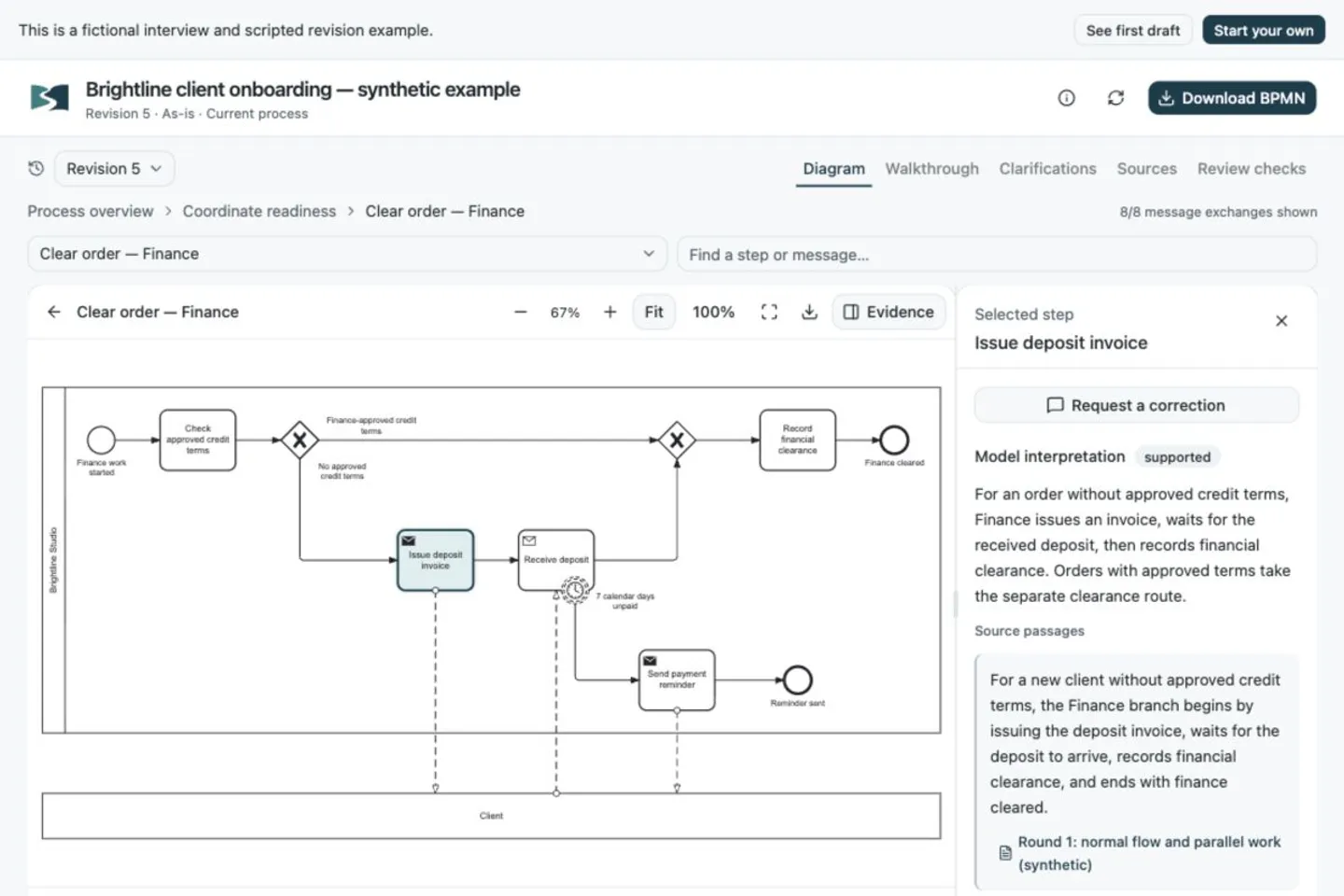
From a conversation to a process people can review
A process interview rarely arrives as a complete sequence. Someone might describe what happens, then mention an exception later, or leave the order of two steps unclear. A diagram can make those gaps easier to discuss when the reader can see what came from the conversation and what still needs an answer.
I built Senda as an independent process discovery tool. It helps an agent and a person turn interview material into a reviewable BPMN model. BPMN is a standard format for describing processes in diagrams. The examples and interviews shown here are synthetic.
A reusable skill guides an existing modeling agent through boundaries, activities and events, responsibilities and handoffs, control flow, and supporting detail. The method draws on Chapter 5 of Fundamentals of Business Process Management. The agent interprets the material and proposes changes; the product does not require its own model or provider key.
Senda runs on Cloudflare Workers with private projects and agent connections. The screenshots show the running local application.
Leave the gap visible and ask
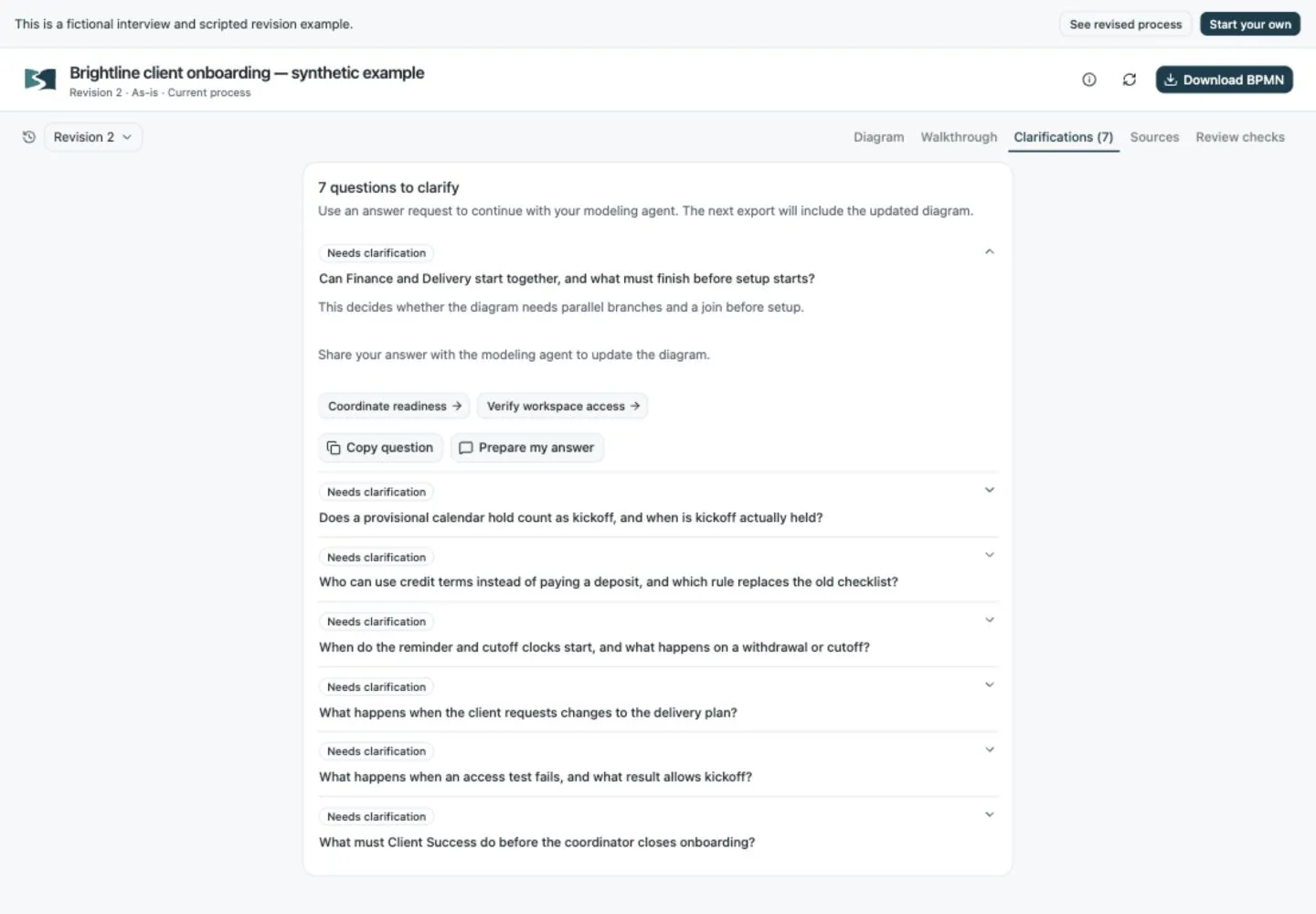
In the small example, the interview says to “collect a deposit and schedule the project.” That sentence does not say which happens first. The draft keeps the order unresolved and presents a question.
In the private project app, a person can save an answer as a new source. The question remains visible until the modeling agent interprets that answer and updates the model with supporting evidence. As the agent saves revisions, the browser detects updates; the reader can also inspect earlier versions.
The review shows the diagram alongside exact source quotations. A reader can search for a step and open its evidence; evidence starts collapsed so the process remains readable.
Separate the current process from a plan
Each project distinguishes the As-is process from a To-be plan. A person starts the plan with a design brief and a selected saved As-is revision. Senda copies that diagram as an unconfirmed starting point, then keeps the plan’s sources, questions, and revision history separate.
Current claims and approvals do not become future facts. Later changes to the As-is model leave the plan’s original baseline intact, so a reader can see what the proposed work started from and review it on its own terms.
Connect an agent to a private project
I extended the same project core used by the local command-line tool to support account-owned projects in the web app. A person chooses which project to grant an agent through an OAuth consent flow. The agent can then read sources and questions and propose revisions through an MCP connection, using the downloadable discovery skill for the method.
Keep access tied to the owner's choice.
The service checks project ownership and the agent’s explicit grant before opening a project. Disconnecting agents removes grants and revokes existing access and refresh tokens. Agent tools cannot record a person’s approval.
Save the model and its sources together.
Claims link to source quotations and diagram element IDs. Transcripts and clarification answers remain intact as new revisions are added. On Cloudflare, D1 stores revision records and private R2 stores immutable model snapshots. A conditional write publishes the model and its evidence together; stale edits, invalid batches, and invalid evidence references cannot leave a partial update. The local tool uses SQLite for its revisions.
Use a modeling library for the diagram.
Miragon supplies BPMN operations, validation, layout, and rendering. Senda adds source evidence, clarification state, revisions, and review around those operations. The local CLI and offline review bundles remain available.
Make a larger process navigable
The larger synthetic example follows a client onboarding process across five internal roles and a client. It includes parallel work, payment reminders, withdrawal and refund conditions, corrections, and handover. The overview stays compact; readers can open details for individual parts of the work without losing the external exchanges that give them context.
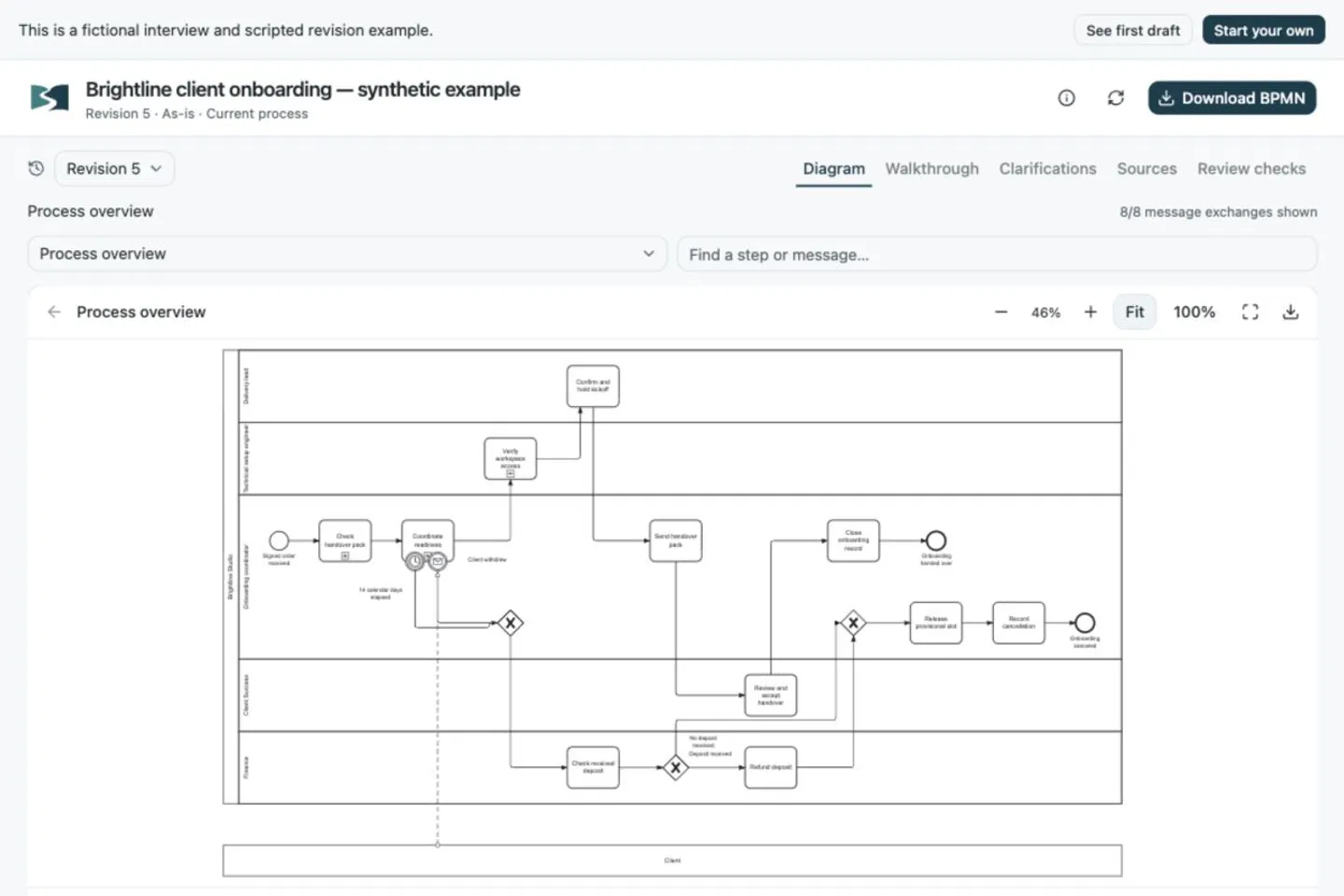
The saved model can be exported as a complete BPMN file with improved diagram geometry. Separate scoped files preserve the external participants shown in each view and identify themselves as partial. The original saved XML is retained. I checked exports in one independent BPMN editor; appearance and external-pool support can vary between editors.
A layout decision beyond the crossing count
I compared the current layout with an experimental adapter using ELK, a graph layout engine, on the larger example. I found a routing issue in my own implementation: it treated intervening lane bodies as obstacles. Fixing that reduced overview crossings from two to one without enlarging the diagram; all five detail views remained free of crossings.
An ELK-based alternative eliminated the remaining overview crossing, but made the drawing taller and produced longer routes and backward handoffs. Some detail views also gained crossings. I kept the corrected current renderer and left ELK experimental. This comparison covers one synthetic model and a bounded adapter, not every process or layout engine.
What I checked
The larger synthetic example moves from seven open questions to zero through three scripted clarification rounds. Its twelve cases for human review remain unapproved. On the live deployment, I checked email sign-in, then used the official MCP client SDK to revise the As-is model and a separate To-be plan. The checks included a saved clarification answer, matching BPMN exports, an unchanged As-is model during planning, and immediate agent revocation. Commercial agent clients have not yet been tested.
These checks exercise the implementation, evidence, and persistence. They do not measure independent AI extraction or establish that a model accurately represents a real process. Structural checks also cannot determine whether a diagram is complete or clear to its intended reader. A real transcript and review with the people who do the work are needed to assess discovery quality in practice.
Cloudflare Email Service sends single-use sign-in links, with a confirmation page before sign-in. I tested the flow through a real inbox, checked that a link could not be reused, and confirmed the existing account and its As-is and To-be projects remained intact.
Need something like this built?
I work with businesses, founders, and agencies from the first call through launch and handoff. I’m taking on new projects now.