Codex Telegram Bridge
Routes Codex updates, replies, and approvals through Telegram or Discord while the local computer remains in control.
Project overview · 44 seconds
I built an open-source bridge so Codex work can continue over Telegram or Discord
I built an open-source bridge so Codex work can continue over Telegram or Discord while I am away from the desk.
Codex can keep working while I step away, but the default interaction model assumes I am still in front of the desktop app. A message alone would not solve it. The bridge needed to know when I was away, start or repair the shared live backend, notify only for relevant events, route replies to the right thread, handle approvals, and stop cleanly when I returned.
Away mode controls when messages can leave the computer
Make presence the top-level gate.
The main rule is simple: remote notifications stay off while I am at the computer. /away turns delivery on, while /back turns it off and clears pending messages.
Route every reply through local records.
The bridge stores thread snapshots, outgoing messages, delivery history, reply routes, approval routes, selected projects, and action history in a local database. A remote message carries a temporary route that the local service maps back to Codex.
Keep chat delivery separate from agent access.
Telegram and Discord handle delivery and replies. Hermes gets a small optional interface for trusted local agent tasks: it can inspect, reply, and approve, but it cannot install the background service, configure chat connections, process updates, or send proactive notifications.
The implementation keeps remote control narrow
Select projects without guessing from chat.
The project list stores approved folders with identifiers, labels, and aliases. /project chooses the current workspace, and /new starts a Codex task in that registered folder.
Keep secrets out of command output.
Setup writes the bridge config with user-only permissions, command output redacts bot tokens, allowed user ids can restrict inbound commands, and the public docs call out dedicated bot-token ownership and local retention.
Put the common controls in the menu bar.
The macOS companion exposes the actions needed from the desktop: start, stop, repair, refresh status, open configuration, and inspect local state.
Remote access stays behind local state and explicit presence
Codex Telegram Bridge keeps presence, thread state, reply routes, delivery, and recovery on the local machine while Telegram or Discord carries the messages.
The common remote actions are easy to find.
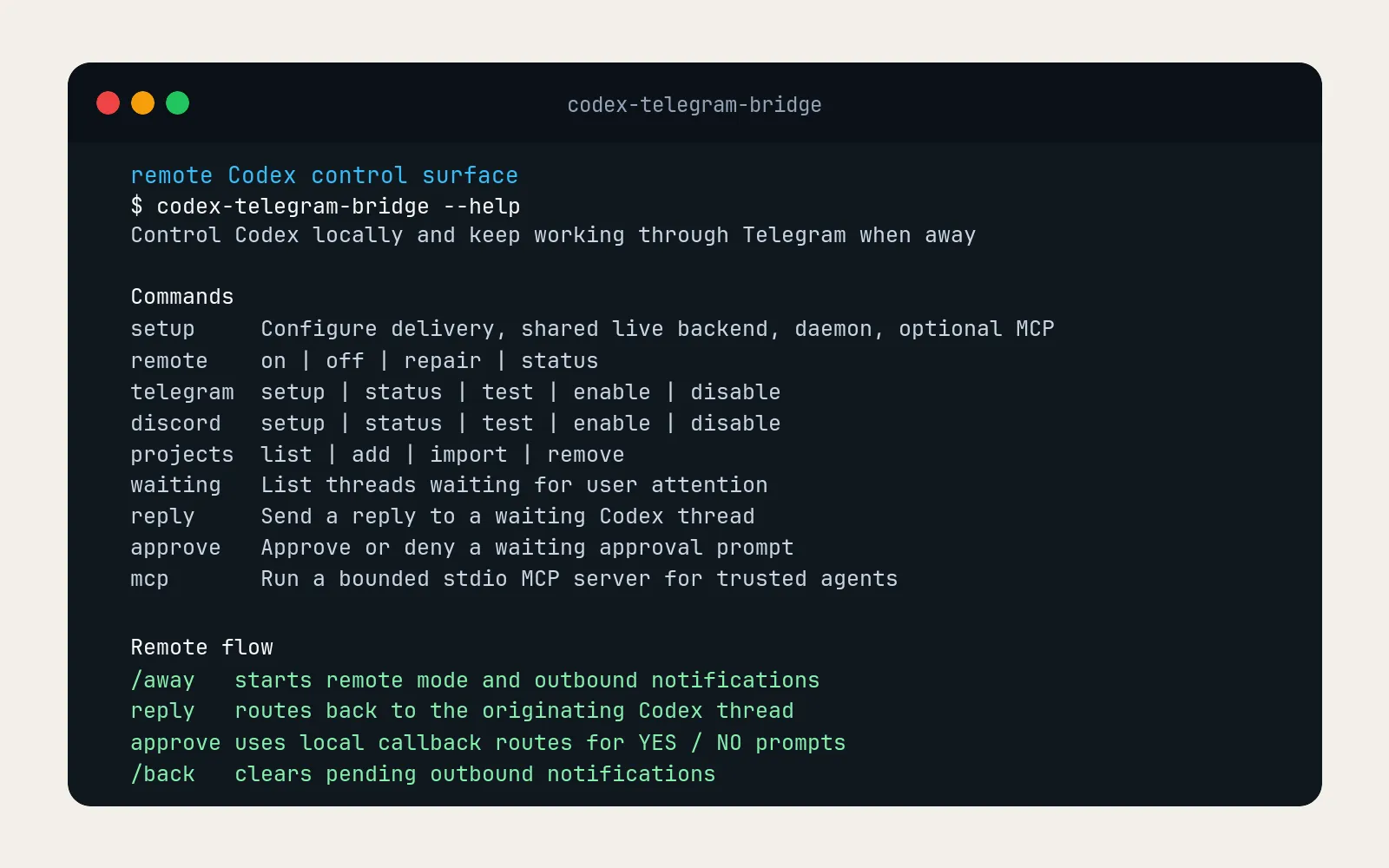
Default help shows setup, remote mode, Telegram and Discord, projects, waiting threads, replies, and approvals while lower-level maintenance commands stay hidden.
Remote notifications only run when remote mode is on.
`/away` enables Telegram or Discord notifications and starts the required local connection. `/back` turns notifications off and clears messages that have not been sent.
Chat replies map back to exact Codex threads.
The local background service records where each Telegram or Discord message came from, then sends a remote reply or approval back to the exact Codex thread.
Hermes can inspect and respond without controlling delivery.
The optional agent interface can inspect threads, show waiting work, reply, and approve. Setup, background-service control, chat connections, new threads, and archive operations remain outside it.
Remote mode has a macOS menu bar control.
The menu bar companion turns remote mode on or off, repairs the local connection, and watches the same state as the chat tools.
The repo includes docs, CI, release workflow, and safety tests.
Tests cover command parsing, hidden maintenance commands, token removal, Telegram reply routing, approval buttons, stored-data changes, agent discovery, and the deliberately small agent tool list.
The implementation is public
The repository includes the Rust bridge, Telegram and Discord setup guides, Hermes agent-interface docs, macOS menu bar companion, example configuration, automated checks, release workflow, and tests.
View GitHub repo →
Tell me what your team needs to ship.
Start with the feature, integration, or system that's stuck. We'll work out whether a project or a monthly contract fits.